
If you are a business owner in the greater Los Angeles area, one of the first questions you will face when upgrading or installing a new sign is whether you need a permit. The short answer is: almost certainly yes. The longer answer depends on exactly where your business is located, what type of sign you want, and which jurisdiction has authority over your property.
Los Angeles County is one of the most complex regulatory environments in the country for commercial signage. With 88 incorporated cities and large swaths of unincorporated territory, the rules change depending on which side of the street your building sits on. Getting this wrong can result in fines, forced removal, and costly project delays.
This guide breaks down the business sign permit process across LA County so you can plan your signage project with confidence.
The City vs. County Trap: Why Your Address Matters More Than You Think
The single biggest source of confusion for business owners in the LA region is understanding whether their property falls within an incorporated city or in unincorporated Los Angeles County. This distinction determines who reviews your permit application, what codes apply, and how long the process takes.
Incorporated Cities are self-governing municipalities with their own planning departments, sign ordinances, and permit processes. If your business is in Glendora, Pasadena, Covina, Azusa, or La Verne, you submit your sign permit application to that city’s planning or building department. Each city sets its own rules about sign size, height, illumination, placement, and design standards.
Unincorporated Areas are governed directly by LA County. These include communities like Altadena, Rowland Heights, Hacienda Heights, and parts of East Los Angeles. If your business is in one of these areas, your permit goes through the Los Angeles County Department of Public Works, typically via the EPIC-LA online portal.
How to Check Your Jurisdiction
The easiest way to determine whether your address is in a city or unincorporated county territory is to use the LA County Assessor’s website or the ZIMAS (Zoning Information and Map Access System) tool provided by the City of Los Angeles. Simply enter your address and the system will display zoning, jurisdiction, and applicable overlays.
If you are located in a city within the San Gabriel Valley — such as Glendora, San Dimas, or Covina — your permit will be handled by that city’s community development or planning department. If the tool shows “Unincorporated Los Angeles County,” then the County Department of Public Works is your permitting authority.
Getting this step right at the beginning of your project saves weeks of wasted effort. Filing with the wrong agency means starting over from scratch.
When Do You Definitely Need a Sign Permit?
While some minor signage may be exempt (more on that below), the vast majority of commercial sign installations in LA County require a permit. Here are the situations where a permit is always required, regardless of jurisdiction.
Illuminated Signs and Channel Letters
Any sign that uses electrical components — including channel letter signs, LED-illuminated cabinet signs, and neon or faux-neon displays — requires both a sign permit and an electrical permit. This is non-negotiable. The electrical work must be performed or supervised by a licensed electrical contractor, and the installation must pass inspection before the sign can be energized.
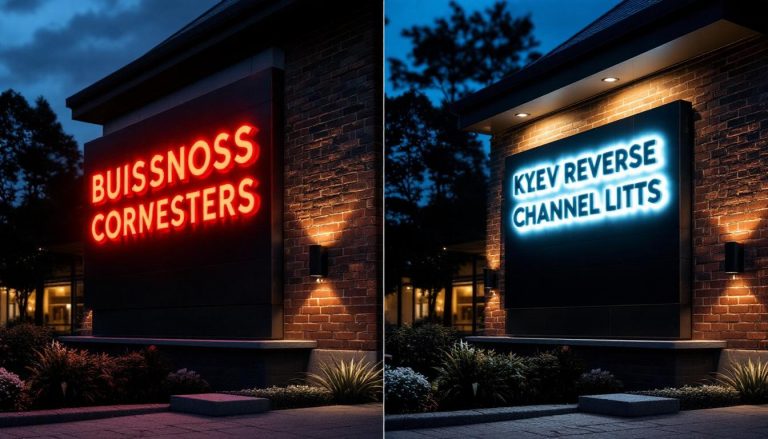
Front-lit channel letters, reverse-lit halo letters, and internally illuminated blade signs all fall into this category. Even retrofitting an existing sign with new LED modules typically triggers a permit requirement because the electrical system is being modified.
Monument Signs and Ground-Mounted Structures
Monument signs are permanent ground-mounted structures that require structural engineering, a concrete foundation, and often a separate building permit in addition to the sign permit. Because these signs involve below-grade construction, they may also require a grading permit or utility clearance depending on the site.
Monument signs are increasingly popular in communities like Glendora and Covina because local ordinances favor low-profile, architecturally integrated signage. But their construction complexity means the permitting process involves more documentation than a simple wall-mounted sign.
Projecting Signs Over Public Right-of-Way
Any sign that extends over a public sidewalk, alley, or roadway requires special approval. These projecting signs — sometimes called blade signs or hanging signs — are subject to minimum clearance heights, maximum projection distances, and structural anchorage requirements. In many LA County jurisdictions, you will also need an encroachment permit from the public works department in addition to the standard sign permit.
Wall Signs Exceeding Size Thresholds
Most jurisdictions set maximum allowable sign area based on the width of the building frontage. If your proposed wall sign exceeds the by-right allowance, you may need a variance, conditional use permit, or sign program approval. These discretionary entitlements add time and cost to the process, so it pays to work with a sign company that understands the local code before you finalize your design.
Exceptions and Exemptions: What You Might Be Able to Install Without a Permit
Not every piece of signage requires a formal permit. However, the exemptions are narrower than most business owners assume. Here are the most common categories of exempt signage in LA County and its cities.
Small Window Graphics and Vinyl Decals
Many jurisdictions exempt window signage that covers less than 25 percent of the total glass area. Simple vinyl decals displaying your business name, hours of operation, or regulatory information (like health department grades) typically do not require a permit as long as they stay within the coverage threshold.
However, if your window graphics are illuminated from behind or if they cover a larger percentage of the glass, a permit may be required. Some cities also distinguish between permanent and temporary window graphics.
A-Frame and Sandwich Board Signs
Portable A-frame signs placed on the sidewalk in front of your business are common, but the rules vary dramatically by city. Some cities in the San Gabriel Valley allow them with a simple sidewalk use permit. Others prohibit them entirely, especially in downtown districts or historic corridors. Always check with your local planning department before assuming these are allowed.
Temporary Banners and Grand Opening Signs
Temporary banners and “Grand Opening” signs are not automatically exempt. Most cities require a temporary sign permit, and they typically limit display periods to 30 or 60 days. In unincorporated LA County, temporary signs are regulated under Title 22 of the County Code, and permits are required for banners over a certain size.
The bottom line: even if you think your sign is “temporary” or “small,” verify with the local authority before installation. The cost of a permit is always less than the cost of a code enforcement citation and forced removal.
The Sign Permit Process: Step by Step
While the specific forms and fees vary by jurisdiction, the general process for obtaining a commercial sign permit in Los Angeles County follows a predictable path.
Step 1: Site Plan and Survey
You will need a scaled site plan showing the location of the proposed sign relative to the building, property lines, streets, and any existing signage. This plan should include dimensions, setbacks, and identification of any easements or utility lines that might conflict with the installation.
Step 2: Sign Design and Elevation Drawings
The permitting agency will require detailed drawings of the sign itself, including front elevation, side profile, dimensions, materials, colors, fonts, and illumination type. For custom building signs, these drawings should be prepared by the sign manufacturer so they accurately reflect the finished product.
Step 3: Structural Calculations
For any sign that is permanently attached to a building, mounted on a pole, or installed as a freestanding ground structure, a licensed structural engineer must prepare calculations demonstrating that the sign and its mounting system can withstand wind loads, seismic forces, and dead loads in accordance with the California Building Code.
Step 4: Application Submission and Plan Check
Submit the completed application package to the appropriate agency. Plan check timelines vary — some cities in the San Gabriel Valley turn around simple sign permits in two to three weeks, while the County can take four to six weeks or longer during busy periods.
Step 5: Permit Issuance and Installation
Once the permit is issued, the sign can be fabricated and installed. The installer must be a California-licensed C-45 Sign Contractor. After installation, the permitting agency will schedule a final inspection to verify that the sign matches the approved plans, the electrical connections are safe, and the structural attachments are sound.
Step 6: Final Inspection and Sign-Off
The inspector will check the sign against the approved drawings, verify code compliance, and confirm that all electrical work has been performed to standard. Once the inspection passes, you receive final sign-off and your sign is legally operational.
Common Mistakes That Delay Sign Permits in LA County
Having worked on hundreds of sign permit applications across the greater Los Angeles area, certain mistakes come up repeatedly.
Filing with the wrong jurisdiction. As discussed above, submitting to the County when you should have filed with the city (or vice versa) resets your timeline to zero.
Incomplete application packages. Missing structural calculations, unsigned landlord consent letters, or low-quality drawings are the top reasons for plan check corrections. Every correction cycle adds one to three weeks.
Ignoring specific plan areas. Many cities in the San Gabriel Valley have specific plan zones — like Glendora’s Foothill Boulevard corridor — with additional design standards. If your sign does not comply with the specific plan, the standard permit process does not apply. You may need a design review hearing.
Assuming a like-for-like replacement does not need a permit. Even if you are replacing an existing sign with one of the same size, a new permit is generally required if the new sign involves different materials, illumination, or structural attachments.
Not getting landlord approval first. Most jurisdictions require a signed landlord authorization letter as part of the permit application. If you are a tenant, secure this letter before you invest in design and engineering.
Why Working With a Licensed Sign Manufacturer Simplifies Permitting
The permit process is manageable when you work with a sign company that handles it as part of their standard service. A qualified sign manufacturer with C-45 licensing and local experience will prepare the site plan, produce code-compliant design drawings, coordinate structural engineering, submit the application, and manage the inspection process on your behalf.
This is one of the key advantages of working with a manufacturer rather than a broker. A broker outsources fabrication and may not have the technical staff to produce permit-ready drawings or respond to plan check corrections efficiently. A manufacturer with an in-house design and engineering team can turn around revisions in days rather than weeks.
For business owners in Glendora, San Dimas, Azusa, Covina, La Verne, and surrounding communities, working with a local sign company that knows the specific requirements of each jurisdiction eliminates the guesswork and reduces project timelines significantly.
Start Your Sign Project the Right Way
Navigating sign permits in Los Angeles County does not have to be overwhelming. The key is understanding your jurisdiction, preparing a complete application package, and working with a licensed sign contractor who manages the process from design through final inspection.
If you are planning a new sign for your business — whether it is illuminated channel letters, a monument sign, or a full rebrand — the smartest first step is a consultation with a team that knows the local codes and can guide you through the permit process without delays.
Request a free quote and let the team handle the permits so you can focus on running your business.